
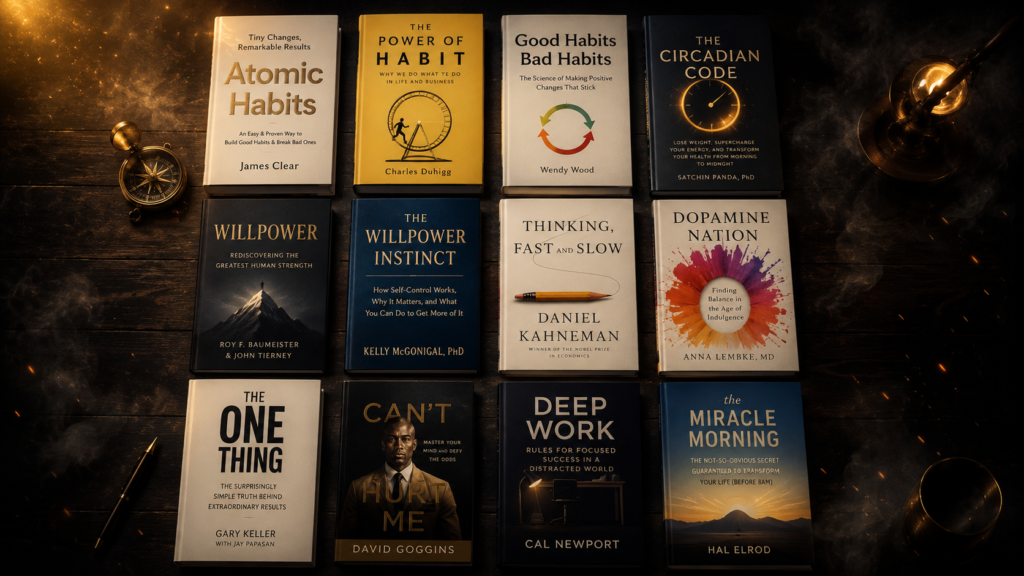
I’ve watched hundreds of habit summaries on YouTube. They’re slick, fast, and forgettable. Then I read the actual books — slowly, repeatedly, across 12 different authors — and realized YouTube had been feeding me the skeleton while the flesh sat untouched on the page.
This is what the books actually taught me. The slow, uncomfortable, paradigm-shifting version.
Why YouTube Summaries Fail You
Let me be clear: YouTube summaries aren’t useless. They’re a brilliant introduction. But habit change is not an intellectual exercise — it’s a biological one. And the biology gets cut from every 10-minute summary in favor of memorable takeaways.
Here’s what gets removed in the edit:
- The nuance between knowing a habit principle and feeling it shift something in your behavior
- The author’s original contradictions, doubts, and revisions — the parts that make the science feel real
- The slow accumulation of evidence across chapters that makes the conclusion land differently
- The personal stories that prime your brain for emotional encoding (which is how memory actually works)
Reading 12 books on habits didn’t give me 12 times the information. It gave me a completely different relationship with the information I already thought I had.
The Real Problem: Summaries optimize for retention of facts. But habits are built through repetition of behavior — not memorization of concepts. The books teach you to think differently. Summaries teach you to quote differently.
Part One: How Habits Actually Form (Books 1–4)
The first four books dismantled everything I thought I understood about willpower, discipline, and motivation. If you’ve only seen the summaries, you probably think habits are about streaks and identity. They’re not. They’re about neurochemistry, environmental design, and timing.
| Book 1 Atomic Habits by James Clear What YouTube misses: The 1% improvement concept goes six layers deeper than any summary shows. Clear’s argument isn’t about small steps — it’s about changing the type of person you’re voting to be with each action. The identity framework is subtle and most summaries reduce it to a slogan. “Every action you take is a vote for the type of person you wish to become. No single instance will transform your beliefs, but as the votes build up, so does the evidence of your new identity.” |
| Book 2 The Power of Habit by Charles Duhigg What YouTube misses: Duhigg’s research on keystone habits — the ones that unintentionally trigger other habits — is almost entirely absent from YouTube summaries. Understanding that exercise doesn’t just burn calories, it neurologically primes discipline in every other domain, is life-changing. Summaries give you the cue-routine-reward loop. The book gives you the science of why some habits cascade. “Keystone habits say that success doesn’t depend on getting every single thing right, but instead relies on identifying a few key priorities and fashioning them into powerful levers.” |
| Book 3 Good Habits, Bad Habits by Wendy Wood What YouTube misses: This is the book that most needed to be read and least often gets recommended. Wood is the world’s foremost habits researcher and her insight — that 43% of daily behaviors are habits performed without conscious thought — completely reframes where change needs to happen. Not in your motivation. In your context. “When we try to change our habits, we focus on motivation. But motivation is fleeting. The secret is in situation design — how your environment shapes what you do before you even consciously decide.” |
| Book 4 The Circadian Code by Satchin Panda What YouTube misses: Almost no habit book or summary addresses timing. Panda’s research on circadian rhythms reveals that when you practice a habit matters as much as how you practice it. Trying to install a morning journaling habit at night, or an exercise habit at a time your cortisol is crashing, is biologically working against yourself. This changed my entire scheduling logic. “Your body has a master clock in your brain that coordinates all other clocks in every organ and cell. When your daily habits work with this clock, everything gets easier.” |
Part Two: Why You Break Good Habits (Books 5–8)
Most habit content focuses on building. These four books taught me something more valuable: why intelligent, motivated people systematically destroy their own habits — and what’s happening neurologically when they do.
| Book 5 Willpower by Roy Baumeister & John Tierney What YouTube misses: The ego depletion research — the idea that willpower is a finite resource that drains across the day — is mentioned in summaries but almost never explored properly. Baumeister’s studies show that judges make harsher decisions before lunch. That glucose literally restores decision quality. That the structure of your day, not your character, determines your discipline. Summaries skip the studies. The studies are the argument. “The most important factor in whether people achieved their goals was not whether they had a plan or a reward or even strong desire. It was whether their environment required them to make fewer decisions.” |
| Book 6 The Willpower Instinct by Kelly McGonigal What YouTube misses: McGonigal bridges neuroscience and behavior change in a way that no summary captures. Her chapter on how stress physically contracts the prefrontal cortex — the exact region that governs long-term decision making — explains why you break your diet when you’re overwhelmed. It’s not weakness. It’s anatomy. “When you’re under chronic stress, the prefrontal cortex loses ground to more primitive brain systems. You become less you, and more your impulses. The antidote is not more willpower — it’s reducing the biological cost of restraint.” |
| Book 7 Thinking, Fast and Slow by Daniel Kahneman What YouTube misses: Kahneman’s magnum opus is rarely framed as a habit book, but it’s the single most important book for understanding why habit change fails. System 1 (automatic, fast, habit-driven) and System 2 (deliberate, slow, effortful) are in constant conflict. Habits live in System 1. Intentions live in System 2. Unless you understand how System 1 gets written, your System 2 plans will always lose. “The ease with which material comes to mind is often confused for truth. Familiarity is not the same as correctness — but your brain treats them identically, which is why bad habits feel more natural than good ones.” |
| Book 8 Dopamine Nation by Anna Lembke What YouTube misses: The most confronting book on this list. Lembke’s work on the dopamine see-saw — how every pleasure is followed by an equal and opposite pain — explains why high-stimulation activities (social media, junk food, easy entertainment) neurologically crowd out low-stimulation good habits (reading, exercise, deep work). Summaries present this as “dopamine detox.” The book presents it as a medical framework for rewiring baseline pleasure thresholds. “We’ve engineered away the natural cycles of deprivation that once forced us to struggle, strive, and tolerate discomfort. In doing so, we’ve lost the very mechanisms that made us capable of feeling pleasure from ordinary life.” |
Part Three: Building Habits That Actually Last (Books 9–12)
The final four books moved beyond behavior into something deeper: the psychological and philosophical architecture of a person who changes sustainably. This is the part most people never reach because they’re still stuck trying to fix the symptom (the broken habit) instead of the system (the person maintaining it).
| Book 9 The One Thing by Gary Keller & Jay Papasan What YouTube misses: The domino effect principle — that one habit, done consistently, topples an ever-larger chain of connected behaviors — is buried in YouTube summaries under the simpler message of “focus on one priority.” The actual book forces a confrontational question: not what should I do, but what is the ONE habit that makes every other habit easier or unnecessary? Most people never ask this. Most summaries never teach it. “What’s the ONE Thing you can do such that by doing it, everything else will be easier or unnecessary? Success is built sequentially. It’s one thing at a time.” |
| Book 10 Can’t Hurt Me by David Goggins What YouTube misses: This is not a self-help book. It’s a case study in neuroplasticity — specifically, how deliberate exposure to discomfort physically rewires the brain’s assessment of what’s possible. Goggins’ 40% rule — that when your mind says quit, you’re only 40% done — sounds like motivational hyperbole in summaries. In context, across 300 pages of documented physical and psychological transformation, it reads as a physiological argument. The suffering is the science. “The most important conversations you’ll ever have are the ones you’ll have with yourself. Most of us are operating at 40% of our actual capabilities — not because we lack talent, but because we’ve never been forced to find the other 60%.” |
| Book 11 Deep Work by Cal Newport What YouTube misses: Newport’s argument is really a habit argument in disguise: the ability to focus without distraction is a habit that must be trained like a muscle, and like any muscle, it atrophies without consistent resistance. The summaries give you the “work in blocks” takeaway. The book gives you the neuroscience of myelin sheathing — how deep concentration literally thickens the neural pathways associated with the skill you’re practicing. Focus is not a personality trait. It’s a biological structure you either build or neglect. “The ability to perform deep work is becoming increasingly rare at exactly the same time it is becoming increasingly valuable in our economy. As a consequence, the few who cultivate this skill will thrive.” |
| Book 12 The Miracle Morning by Hal Elrod What YouTube misses: Controversial to include, given that it’s the most practically simple book on this list. But Elrod’s insight about morning routines deserves its place: the first hour of the day, before external stimuli colonize your prefrontal cortex, is the highest-leverage habit window you have. The SAVERS framework (Silence, Affirmation, Visualization, Exercise, Reading, Scribing) isn’t magic. It’s a structured way to use your peak prefrontal window before decision fatigue begins. Summaries make it sound like a ritual. It’s really a biological optimization strategy. “How you wake up each day and your morning routine dramatically affects your levels of success in every single area of your life. The way you start the day sets the tone, the context, and the direction for the rest of it.” |
The 5 Things 12 Books Taught Me That No Summary Ever Did
1. Habits are biological, not moral
Breaking a habit is not a character failure. It’s a neurochemical event. Every book on this list — from Duhigg to Lembke to Kahneman — makes the same argument in different language: your brain is doing exactly what it was designed to do. The problem is that it was designed for an environment you no longer live in. Change the environment before you try to change the behavior.
2. Willpower is a resource, not a character trait
Baumeister and McGonigal settle this definitively across hundreds of studies: willpower depletes. The high-performers you admire don’t have more of it — they’ve structured their lives to spend less of it. Decision fatigue is real. Ego depletion is real. Your job is not to strengthen willpower but to design systems that require less of it.
3. Timing is as important as technique
Panda’s circadian research and Newport’s myelin science converge on one conclusion: the when matters as much as the what. Installing your hardest habits at your biological peak window — typically 2–4 hours after waking — isn’t a productivity hack. It’s working with your neurobiology instead of against it.
4. Identity precedes behavior — but behavior creates identity
Clear’s identity framework in Atomic Habits sounds circular until you read Baumeister’s willpower research alongside it. The reason identity-based habits are more durable is neurological: they reduce the cognitive load of each individual decision. When “I am a reader” is your identity, deciding to read tonight costs almost nothing. When “I want to read more” is your intention, it costs willpower every single time.
5. The ONE habit changes everything
Keller and Goggins reach the same conclusion from completely different angles: compounding doesn’t happen from doing many things slightly better. It happens from doing one foundational thing so consistently that it restructures everything around it. Find the habit that, if you did it every day, would make every other habit easier. For most people, it’s sleep, movement, or a morning routine. Start there. Not with a 12-step system.
Your Reading Journey: The Right Order to Read These 12 Books
Don’t read them in the order I listed them. Read them in the order your brain can absorb them:
Phase 1 — Understand the system (read first)
- The Power of Habit (Duhigg) — learn the loop
- Thinking, Fast and Slow (Kahneman) — understand your two operating systems
- Good Habits, Bad Habits (Wood) — context and environment design
Phase 2 — Build the foundation (read second)
- Atomic Habits (Clear) — implementation and identity
- The Circadian Code (Panda) — timing your habits
- The Miracle Morning (Elrod) — the morning anchor habit
Phase 3 — Protect your progress (read third)
- Willpower (Baumeister) — manage your decision energy
- The Willpower Instinct (McGonigal) — stress and the prefrontal cortex
- Dopamine Nation (Lembke) — recalibrate your baseline
Phase 4 — Elevate (read last)
- The One Thing (Keller) — find your keystone habit
- Deep Work (Newport) — build the focus muscle
- Can’t Hurt Me (Goggins) — expand your ceiling
This is what I call the Reading Journey approach — reading books in a sequence designed to build understanding layer by layer, not just consume information in isolation. The transformation doesn’t come from any single book. It comes from how they talk to each other.
The Final Honest Word
YouTube summaries will tell you what habits are. These 12 books will change what you are.
The difference isn’t information. It’s immersion. When you sit with an author’s argument for 300 pages — when you can’t escape the evidence, can’t skip to the key takeaway, can’t pause at the convenient moment — something different happens in your brain. The concept stops being content. It becomes conviction.
That’s what summaries can never give you. Not because they’re badly made, but because conviction cannot be compressed.
Start here: If you’re only going to read ONE book from this list, read The Power of Habit by Charles Duhigg. It’s the most complete first step into the science — and it will make every other book on this list more meaningful when you get to it.
If you want a curated reading guide that maps each of these books to your specific life situation — with a personalized reading order and the key lessons to look for in each chapter — I’m building exactly that. Follow @achievers_corner and be the first to know when it drops.